

Vinted is the cleaner test when you have clothes that can explain themselves fast: a decent sweater, jeans with real measurements, a wearable vintage tee, a jacket with an honest condition note. Mercari has the wider anything-goes marketplace energy, which can help when your stock is mixed or the buyer may arrive through a very specific search. The important difference is not which app has the better logo. It is whether your item needs a quick closet decision or a broad marketplace search, and whether its price survives the fees and checkout total.
- Try Vinted for straightforward clothing, approachable vintage, and listings where the garment does the talking.
- Try Mercari for mixed inventory or pieces that may need a broad search buyer instead of a fashion-first shopper.
- Do the fee math from net payout and buyer checkout, then run a small batch before moving the whole rack.
The useful difference is what each app asks the buyer to do
A Vinted listing has to make sense almost immediately. The photo, size, condition, and price need to answer the ordinary buyer question: would I actually wear this? That is a good room for clean denim, everyday brands, useful layers, and vintage that does not need a dissertation.
Mercari can make more room for a buyer who is searching for a particular thing. That can suit a discontinued hoodie, a niche character tee, a hard-to-find size, or a seller whose storage room contains clothes next to electronics and home goods. The same piece can work on both. The workflow is what changes.
The fee answer is not a bumper sticker
Vinted says selling is free, while the buyer pays shipping and Buyer Protection at checkout. Mercari says US sellers pay a 10% selling fee and buyers pay a 3.6% Buyer Protection fee; both stated fees use the item price plus buyer-paid shipping as their base. Those are real differences, but neither one tells you whether a $16 shirt feels worth buying once the buyer sees the final total.
Do not list a basic item at the number you need emotionally. Start with the amount you want to receive, check the realistic buyer total, and compare that with what similar clothes actually sell for. Margin that prevents a sale is just a screenshot.
- Vinted: seller-side simplicity; checkout costs matter to the buyer.
- Mercari: a 10% seller fee; account for it before accepting an offer.
- Both: lower-priced single items need enough value to justify shipping.
Sort the rack before you list
Put the obvious clothes in the Vinted test pile: clean knits, denim, simple dresses, recognizable mall brands, and vintage that reads from a hanger. Put research-heavy or mixed-category inventory in the Mercari pile: strange sizes, discontinued pieces, collectibles that happen to be wearable, and anything whose buyer will probably type an oddly specific search.
Then give each platform twenty comparable listings. Same photo standard. Same honest measurements. Same week. Track questions, favorites, offers, sale price, and how much time each app asks from you after the listing goes live.
Do not let cross-listing become a missing-item machine
Cross-listing is useful only when the record of truth is useful too. If a jacket sells on one app, it needs to disappear from the other before a second person buys it. That sounds basic until you have forty listings, two phones, and a packing table covered in mailers.
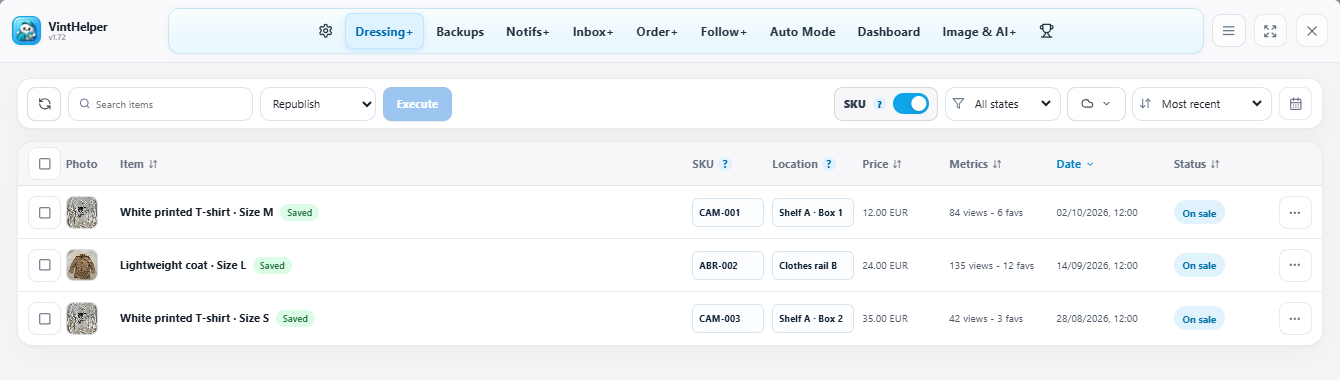
For sellers who decide Vinted deserves a regular place in the rotation, VintHelper is useful for the Vinted-specific work: backups, wardrobe review, controlled reposting, favorite offers, photo cleanup, and order tracking. It does not cross-list to Mercari, so keep your inventory system honest.
Include the shipping in the fee base
Example: a $25 item plus $5 of buyer-paid shipping gives Mercari a $30 fee base. At 10%, the selling fee is $3; the buyer's 3.6% Buyer Protection charge on that base is $1.08, before any applicable tax. Keep the shipping amount and its cost separate when calculating what remains for you.
Mercari describes that buyer charge as Buyer Protection, not an additional payment-processing fee. Use the order's actual numbers rather than subtracting 10% only from the garment price.
| Illustrative Mercari transaction | Amount |
|---|---|
| Item | $25.00 |
| Buyer-paid shipping | $5.00 |
| Seller fee: 10% of $30 | $3.00 |
| Buyer Protection: 3.6% of $30 | $1.08 |
FAQ
Is Vinted or Mercari better for selling clothes?
Vinted is a strong test for straightforward clothing and wearable vintage. Mercari can make more sense for mixed inventory, niche searches, and items that need a broader marketplace buyer.
Does Mercari charge a seller fee?
Mercari says US sellers pay a 10% selling fee. Check its current fee page before pricing because marketplace policies can change.
Can I list the same clothes on Vinted and Mercari?
Yes, if you can remove sold items quickly and keep a single accurate inventory record. Start with a small batch rather than copying your entire closet at once.